Business Success Pathway for Veterans
MISSION
To empower transitioning veterans and active reservists with the business knowledge, cultural acumen, and strategic mentorship needed to successfully navigate, enter, and thrive in civilian careers — particularly within the private sector. VCTP transforms military skills and leadership traits into business-ready assets, preparing veterans not only to secure a job but also to lead with purpose in corporate America and beyond.
VISION
VCTP will become the gold standard for veteran transition programs — a scalable, nationally recognized business and career-readiness model that provides lifelong support, tailored training, and strategic networking, allowing every veteran to leverage their service into success.
PROGRAM STRUCTURE
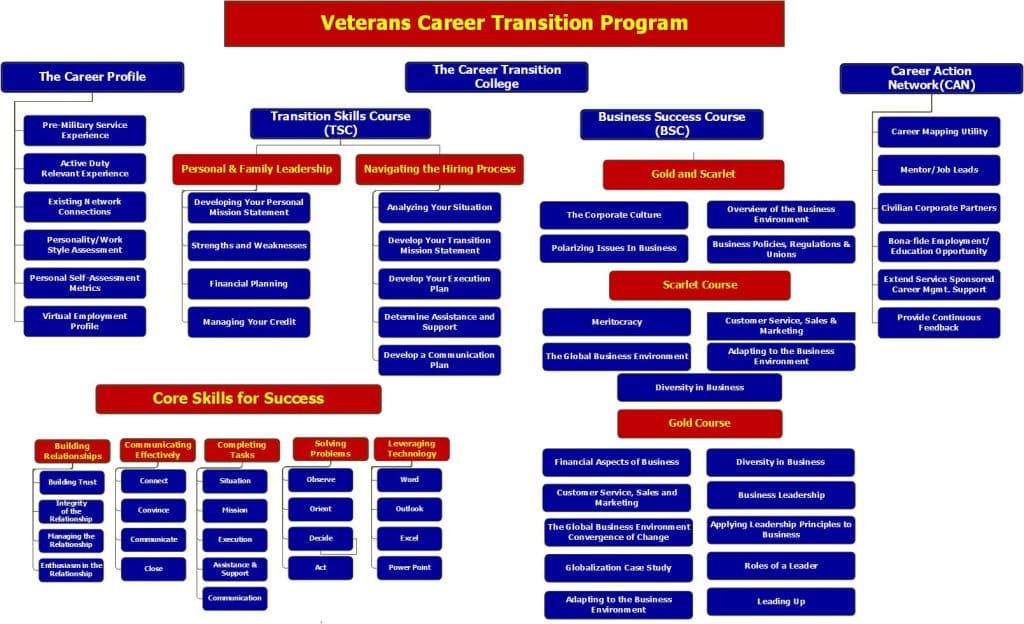
The program is divided into three progressive phases that guide the veteran from self-assessment through business integration, with sustained support long after initial placement.
Phase 1: Veteran Business Career Profile
- Personalized intake system that maps each veteran’s Military Occupational Specialty (MOS), leadership experience, personal goals, and business interests.
- Use of AI-driven platforms to match strengths with industry verticals.
- Baseline assessments for business competencies, career readiness, and soft skills.
Phase 2: Business Readiness Academy (Formerly “Transition College”)
This intensive training program includes three targeted modules:
A. Transition Skills Course
- Civilian business communication, networking, and professional etiquette.
- Emotional intelligence and interpersonal skill-building.
- “Translating the Uniform”: How to pitch your service background in a corporate setting.
B. Business Success Course
- Introduction to core business functions (operations, finance, sales, HR, project management).
- Comparative analysis: Military chain-of-command vs. corporate structure.
- Veteran leadership advantage in the business world.
C. Career Launch Capstone
- Resume and LinkedIn branding tailored to business roles.
- Mock interviews with veteran business leaders.
- Industry roundtables with hiring managers, DEI recruiters, and entrepreneurs.
Phase 3: Veteran Career Management Center (VCMC)
- A “career sustainment engine” offering continuous access to jobs, education, and mentorship.
- Think “LinkedIn meets USAA”: A private, veteran-centered platform for professional growth.
- Features:
- Ongoing mentorship and coaching.
- Veteran-alumni network.
- Corporate partner access point.
- Real-time career advancement tools and tracking.
STRATEGIC PARTNERSHIPS
- Employers, chambers of commerce, and veteran-friendly business coalitions will be engaged to offer internships, hiring pipelines, and direct mentorship.
- MOUs with industry leaders to support veteran recruitment and development initiatives.
KEY OUTCOMES
- Translate military service into business success.
- Ensure veterans are not only employable—but competitive in today’s economy.
- Build a sustainable, lifelong career support framework tailored for veterans.
VCTP: Business Readiness Academy
Phase 2 of the Veteran Career Transition Program
Core Purpose
To equip veterans with the critical skills, business cultural awareness, and personal branding tools required to enter and excel in the private sector. This academy is a business-focused “boot camp” that blends soft skills, technical understanding, and professional mentorship into a transformative learning experience.
Module 1: Transition Skills Course
Personal & Professional Adaptation
Goal: Help veterans understand how to effectively present their military experience in a business context while developing foundational interpersonal and self-awareness skills.
Topics Covered:
- Translating MOS into business competencies
- Civilian vs. military workplace culture
- Effective interpersonal communication (verbal, written, virtual)
- Emotional intelligence in team settings
- Conflict resolution and stress management
- “What to leave behind” from military culture
- Building your personal brand
Deliverables:
- Completed Personal Communication Style Profile
- Myers Brigga, StrengthsFinder or DiSC results
- Initial LinkedIn bio draft
Module 2: Business Success Course
Understanding the Corporate Landscape
Goal: Provide veterans with a practical understanding of business operations, industry structure, and how to thrive inside organizations as leaders and team players.
Topics Covered:
- Business 101: Understanding corporate departments (HR, Ops, Finance, Marketing, Sales)
- Project management fundamentals
- Understanding for-profit and nonprofit models
- Financial literacy & budgeting (personal and business)
- Sales, networking, and relationship building
- Risk management, compliance, and decision-making in business
Special Segment:
Veteran Advantage in Business Leadership
- How Marines, Soldiers, Sailors, and Airmen lead differently—and why it matters in corporate America
Deliverables:
- Completed “Business Literacy” Mini-Certification
- Networking Pitch & Business Card Exercise
- Problem-Solving Case Study (team project)
Module 3: Career Launch Capstone
Preparation for Civilian Career Entry
Goal: Prepare veterans to confidently compete for, secure, and thrive in professional employment opportunities.
Topics Covered:
- Resume translation and optimization (MOS-to-business language)
- LinkedIn profile building & optimization
- Mastering behavioral and panel interviews
- Crafting your 30-second elevator pitch
- Dress for success & business etiquette
- Industry roundtables and mock interview sessions
- Goal-setting and 90-day transition planning
Deliverables:
- Completed Resume (reviewed by mentor)
- Finalized LinkedIn profile
- Career Action Plan (education, training, or job target)
- Business mentor introduction & match
Supplemental Tracks (Electives)
Optional content tracks for more specialized paths:
- Entrepreneurship & Small Business Launch
- Government Contracting & Procurement
- Sales, Insurance, and Financial Services
- IT & Cybersecurity Certification Prep
- Logistics & Supply Chain Careers
Instructional Format
- Blended learning: in-person workshops, virtual modules, and asynchronous exercises
- Guest speakers from industry (veteran executives, hiring managers)
- One-on-one mentoring check-ins
- Small group cohort collaboration
Success Metrics
- Graduation from all modules
- Interview-ready resume and profile
- Minimum 1 job interview or professional meeting scheduled within 30 days of program completion
- Career mentor assigned to each graduate
Excellent — here is a fully developed Mentorship Program Model for the Veteran Career Transition Program (VCTP), designed specifically to leverage experienced veterans and professionals like Mr. Esposito to mentor justice-involved veterans and other participants as they transition into the civilian business world.
VCTP Mentorship Program Model
Empowering Veterans Through Peer-Led, Professionally Guided Mentorship
🎯 Purpose of the Mentorship Program
The VCTP Mentorship Program provides structured, impactful mentorship to veterans navigating the transition to civilian employment, education, or training — with a special emphasis on business readiness. The program draws on the lived experience of successful veterans, entrepreneurs, and civic leaders who have walked this path and are committed to guiding others through it.
Core Objectives
- Translate military experience into business acumen with guidance from those who’ve done it successfully.
- Provide moral, professional, and tactical support during the most vulnerable phase of post-service transition.
- Create a sustainable, veteran-to-veteran support network that extends far beyond the initial job placement.
Mentor Eligibility & Profile
Mentors may be:
- Veterans who have successfully transitioned into business, government, or education roles.
- Civic leaders or professionals with a strong record of service to the veteran community.
- Approved participants fulfilling a restorative role through structured court-supervised mentoring (e.g., Mr. Esposito).
Mentor Criteria:
- Commitment to the VCTP mission and values.
- Willingness to complete mentor training and submit to periodic review.
- Ability to meet with assigned mentee(s) at least biweekly.
- Strong interpersonal skills, empathy, and discretion.
Mentee Profile
- Veterans enrolled in the VCTP through the Veterans Court or voluntary intake.
- Justice-involved veterans seeking career support and guidance.
- Participants in transition from active duty, National Guard, or Reserve components.
Mentees will receive:
- A designated mentor aligned with their goals, background, and desired career field.
- A clear development plan tracked through the VCTP platform.
- Access to alumni, employer introductions, and weekly resource updates.
Mentor Responsibilities
- Participate in the Mentor Orientation & Training Session
- Guide mentee in developing and executing their Career Action Plan
- Conduct regular check-ins (in person, phone, or virtual)
- Provide feedback and progress notes to the Program Director
- Attend quarterly Mentor Cohort Review Meetings
- Model professional behavior and character aligned with VCTP values
Mentorship Lifecycle
| Stage | Time Frame | Activity |
| Orientation & Match | Week 1 | Mentor onboarding and pairing |
| Goal Setting | Weeks 2–3 | Collaborative Career Action Plan (CAP) creation |
| Active Mentorship | Weeks 4–12+ | Biweekly mentoring sessions, job prep, business immersion |
| Capstone Phase | Week 12+ | Review of outcomes, ongoing mentorship or handoff to VCMC |
| Alumni Engagement | Post-Program | Optional long-term connection and networking support |
Program Support & Oversight
- Mentors are assigned a Mentor Coordinator for guidance and troubleshooting.
- All mentor-mentee relationships are tracked in the VCTP system with secure documentation and feedback tools.
- Mentors receive resources, training, and optional CEUs for participation.
Success Metrics
- % of mentees who secure employment, education, or training within 90 days
- % of mentees reporting increased confidence, job readiness, and satisfaction
- Mentor retention and engagement rates
- Career growth of mentees tracked at 6, 12, and 24-month intervals
Legal & Compliance Notes (for Justice-Involved Participants)
- Mentors assigned as part of court-structured probation must:
- Sign a court-approved Memorandum of Understanding (MOU)
- Submit to scheduled performance reviews
- Remain in good standing with court compliance officers
- Be supervised directly by the Veterans Court Program Director